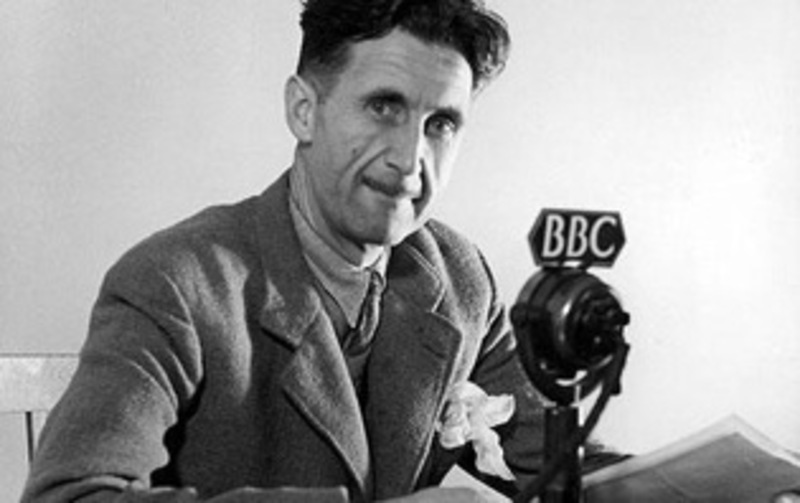
As I was researching Nineteen Eighty-four in Chinese, I wondered whether Orwell ever wrote about China. His interest in India, where he was born in 1903, is well known, and he served in the Burma Police after leaving school and before becoming a writer, but my guess was that China didn’t concern him greatly. But when I went to the British Library to check in his massive, 20-volume Complete Works [CW], I was surprised to discover that he wrote quite a lot about China and its fate under Japanese occupation, in particular when he was working for the BBC’s Eastern Service during World War II.
And of direct relevance to this article, it turns out that he asked his publishers to send a copy of Nineteen Eighty-four to his colleague, the literary critic William Empson in Peking, where he was teaching English literature. When he was seriously ill in a sanatorium in Gloucestershire in 1949, Orwell wrote to his agent Leonard Moore:
“William Empson in China has asked for a copy of 1984 [sic]. I think it might be wise to get two copies sent, one from London and one from New York. He already seems uncertain as to whether his letters are being opened, so could you ask both publishers not to enclose the usual card saying ‘Compliments of the Author’, as this might just conceivably be embarrassing to him.”
Helpfully he gave Empson’s address as 11, Tung Kao Fang, Near Peking Normal University, Peiping 9, China (30 August 1949, CW, vol 20, p 162).
It so happens that a neighbour of mine was a close friend of the Empsons and a couple of years ago she introduced me to their son Jacobus, who has written a book about his parents’ unconventional marriage and his childhood in Peking. Jake tells me that not only did at least one copy of Nineteen Eighty-four arrive safely in Peking, but that he remembers his parents reading it so eagerly that “they had to tear it in half so they could both read it at once!” (J. Empson, email to the author, 8 March 2014).
Orwell had written three months earlier that
“I had vague ideas of writing [to Empson], but thought it might be embarrassing for foreigners in China to get letters from outside at the moment. Hetta, Empson’s wife, is or used to be a Communist, & he himself is not particularly hostile to Communism, but I doubt whether that would do much good under a Chinese Communist régime”
(letter also from Gloucestershire, to his American publisher Robert Giroux. Orwell adds that “I have been horribly ill for the last month or so…” 19 May 1949, CW, vol 20, p 117). Orwell seems to have been somewhat bemused by the Empsons’ departure for Peking, and in another letter to Giroux, he says: “I’d like to know what he [Empson] has to say about “[King] Lear,” (a reference to Empson’s recent essay on Lear, Tolstoy and the Fool). He has disappeared into China the way people do…” (14 April 1949, CW, vol 20, p 84). Jake says Orwell’s assessment of his parents’ political stances is accurate.
“My mother was a member of the Communist Party from 1937 until 1956, so Orwell was quite correct in her case – my father’s political opinions were more nuanced, as they say these days, but he could have been rightly described as a sympathiser – wearing his Chinese communist uniform when attending a conference in the U.S. in about 1950, for instance.”
But despite Orwell’s suspicions about the Empsons, he did not include them in his famous (or infamous) list of alleged communists that he drew up for the Information Research Department, a branch of the British Foreign Office, a year or two before he died (CW, vol 20, pp 240-259). This list of 135 “crypto-Communists & fellow-travellers” sparked a furore when it finally came to light in the late 1990s, with some denouncing Orwell as a government informer and others defending him because he viewed the Communist Party as a totalitarian menace. The list includes comments such as “Half-Caste…Main emphasis anti-white but reliably pro-Russian on all major issues”.. Empson was a highly influential literary critic who taught in Peking and Kunming in the late 1930s and returned to teach at Peking Normal University from 1947 to 1952, witnessing the last years of the Chinese civil war and the Communist takeover.
Orwell’s main interest in China was related to its attempts to resist the Japanese, who had first invaded the northeast in 1931 and the rest of the country six years later, and he voiced his anger in several BBC scripts. He was appalled at the eye-witness stories of extreme Japanese cruelty that came to his attention at the BBC. With unusual insight, he dated the beginning of World War II not to the German invasion of Poland in 1939 but to the Japanese invasion of China.
“[The war] started, properly speaking, in 1931 when the Japanese invaded Manchuria, and the League of Nations failed to take action. From then onwards, we have seen a long series of aggressions … [I]t was inevitable that Soviet Russia, however anxious to remain at peace, should sooner or later be drawn into the war on the side of the democracies. It was inevitable that Britain and China should ultimately find themselves fighting on the same side, whatever differences there may have been between them in the past …”
Predictably perhaps, Orwell does not seem to have been sympathetic to the Communists, and gives the Nationalists the credit for China’s success in resisting the Japanese. He notes that when the Japanese invaded Manchuria in 1931, “China was in a state of chaos, and the young Chinese republic was in no condition to resist. Six years later, however, when the invasion of China proper began, order had been restored under the leadership of Marshal Chiang Kai-shek, and a powerful national spirit had grown up.” Orwell adds that the main reason the Chinese kept on fighting against enormous odds is that “they are fighting for their liberty, and the will to surrender does not exist in them” (16 May 1942, CW, vol 13, p 324).
He also noted that “This is [Japan's] third war of aggression in 50 years. On each occasion they have wrenched away a piece of Chinese territory and then exploited it for the benefit of two or three wealthy families who rule Japan, with absolutely no regard for the native inhabitants” (17 January 1942, CW, vol 13, p 127).
It was surely Japanese cruelty towards the Chinese that angered Orwell the most.
“By almost universal agreement it is a regime of naked robbery with all the horrors of massacre, torture and rape on top of that. The same will happen, or has already happened, to all the lands unfortunate enough to fall under Japanese rule. Perhaps the best answer to the propaganda which the Japanese put out in India and other places is simply three words LOOK AT CHINA” (13 March 1943, CW, vol 15, p 28).
In Nineteen Eighty-four Orwell envisaged a world divided into Eurasia, Eastasia and Oceania which are continually at war against each other, and shortly after the end of World War Two he envisaged how “More and more obviously the surface of the earth is being parcelled off into three great empires, each self-contained and cut off from contact with the outer world, and each ruled, under one disguise or another, by a self-selected oligarchy.”
“The haggling as to where the frontiers are to be drawn is still going on, and will continue for some years, and the third of the three super-States–East Asia, dominated by China–is still potential rather than actual,” Orwell declared. “But the general drift is unmistakable,” he said, adding rather puzzlingly that “every scientific discovery of recent years has accelerated it” (‘You and the Atom Bomb,’ Tribune, 19 Oct 1945, CW, vol 17, p 320). This seems to be the closest that Orwell got to linking current politics to the horrific world of his final novel.
Orwell is famous for his interest in political language, and this includes the use of appropriate words for various ethnicities, not a matter that troubled many writers of his time but one which concerned him a great deal and which he returned to again and again. In 1943 he wrote to Penguin Books with the corrected proofs of the forthcoming Penguin edition of his first novel, Burmese Days. Apart from correcting a few misprints, “I have also made a few minor alterations,” Orwell says, adding that
“I draw attention to these as it is important that they should not be missed. Throughout, whenever it says in the text, ie. not in the dialogue, I have altered ‘Chinaman’ to ‘Chinese’. I have also in most cases substituted ‘Burmese’ or ‘Oriental for ‘native’, or have put ‘native’ in quotes. In the dialogue, of course, I have left these words just as they stand. When the book was written a dozen years ago ‘native’ and ‘Chinaman’ were not considered offensive, but nearly all Orientals now object to these terms, and one does not want to hurt anyone’s feelings.” (21 November 1943, CW, vol 15, p 338).
Of course “Oriental” is now almost – or just as – objectionable as “Chinaman”, and the words “racist” or “racism” would be bound to crop up in any modern discussion of such terms, but Orwell was surely ahead of his time in his sensitivity to such issues. The word Negro is now archaic, but in Orwell’s time it was a word of respect, and he insisted (more than once) that it should be written with a capital N: in a review of a special supplement to New Republic magazine, entitled The Negro: His Future in America he highlighted how “the facts it reveals about the present treatment of Negroes in the U.S.A. are bad enough in all conscience. In spite of the quite obvious necessities of war, Negroes are still being pushed out of skilled jobs, segregated and insulted in the Army, assaulted by white policemen and discriminated against by white magistrates….
“In Asiatic eyes the European class struggle is a sham. The Socialist movement has never gained a real foothold in Asia or Africa, or even among the American Negroes: it is everywhere side-tracked by nationalism and race-hatred…
“The word ‘native,’ which makes any Asiatic boil with rage, and which has been dropped even by British officials in India these ten years past, is flung about all over the place. “Negro” is habitually printed with a small n, a thing most Negroes resent.” He adds how he has been substituting “Chinese” for “Chinaman” in Burmese Days, adding: “The book was written less than a dozen years ago, but in the intervening time ‘Chinaman’ has become a deadly insult. Even ‘Mahomedan’ is now being resented: one should say ‘Moslem.’ These things are childish, but then nationalism is childish. And after all we ourselves do not actually like being called ‘Limeys’ or ‘Britishers.’” (‘As I Please’, 2, Tribune, 10 December, 1942, CW, vol 16, pp 23-24).
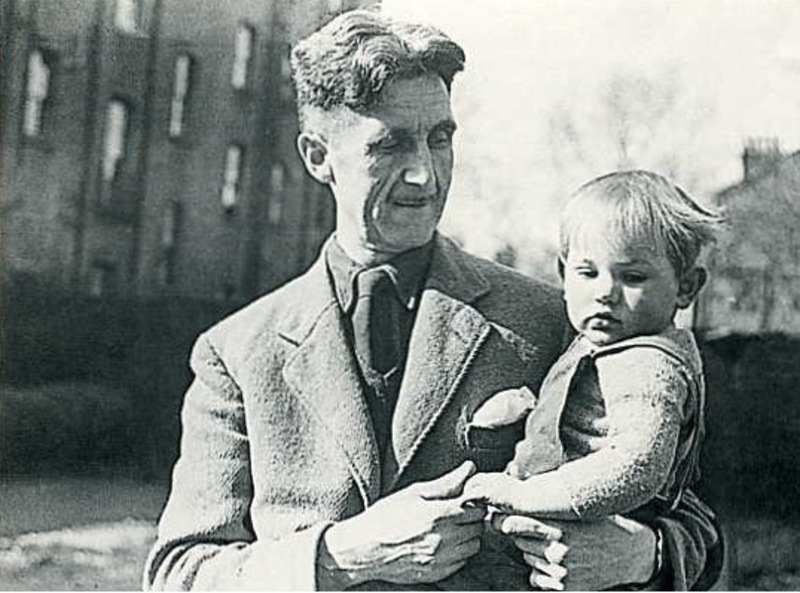
 Orwell holding his adopted son Richard |
Orwell returned to this theme in 1947, devoting an entire ‘As I Please’ column to it. It has an added poignancy because the reason he was looking at a child’s illustrated alphabet is no doubt because he was by now a widower with a small adopted son, Richard. It’s a forceful piece without a wasted word:
Recently I was looking through a child’s illustrated alphabet, published this year. It is what is called a “travel alphabet.” Here are the rhymes accompanying three of the letters, J, N and U.
J for the Junk which the Chinaman finds
Is useful for carrying goods of all kinds.
N for the Native from Africa’s land.
He looks very fierce with his spear in his hand.
U for the Union Jacks Pam and John carry
While out for a hike with their nice Uncle Harry.
The “native” in the picture is a Zulu dressed only in some bracelets and a fragment of leopard skin. As for the Junk, the detail of the picture is very small, but the “Chinamen” portrayed in it appear to be wearing pigtails.
Perhaps there is not much to object to in the presence of the Union Jack. This is an age of competing nationalisms, and who shall blame us if we flourish our own emblems along with all the rest? But is it really necessary, in 1947, to teach children to use expressions like “native’ and “Chinaman”?
The last-named word has been regarded as offensive by the Chinese for at least a dozen years. As for “native,” it was being officially discountenanced even in India as long as twenty years ago.
It is no use answering that it is childish for an Indian or an African to feel insulted when he is called a “native.” We all have these feelings in one form or another. If a Chinese wants to be called a Chinese and not a Chinaman, if a Scotsman objects to be called a Scotchman, or if a Negro demands his capital N, it is only the most ordinary politeness to do what is asked of one. (27 Feb 1947, Daily Herald for Tribune, CW, vol 19, pp 50-51).
As the article below is about translation, I would also like to add Orwell’s touching words that he added to a list of translations of his works (he lists no translation into Chinese but does mention editions of Animal Farm in Japanese and Korean, produced by the U.K. Liaison Mission, Tokyo and the U.S. Army, respectively). He added as a note:
“Some of the above translations, chiefly of ANIMAL FARM, were not paid for. I most particularly do not wish payment to be demanded for translation of any book, article, etc., by any groups of refugees, students, working-class organisation, etc., not in any case where translation will only be made if the rights are given free.
Ditto with reprints in English (I don’t think Braille versions are ever paid for, but in any case I don’t want payment for any that may be made).”
 Orwell’s Nineteen Eighty-four with a banner advertising Murakami Haruki’s 1Q84 |
George Orwell’s Nineteen Eighty-four is just the kind of book that you would expect to be banned in China, all that talk of Big Brother, Newspeak and the rewriting of history is far too close to the bone, surely. So I was amazed to come across it on open sale in a state-run bookshop in Yanji 延吉on the North Korean border in fact.
Nineteen Eighty-four is all over the place in China in fact. A Chinese website lists no fewer than 13 translations published in the PRC between 1985 and 2012, and it’s easy to find at least three or four downloadable or online translations on a quick internet search. Apart from anything else I’m speechless at the amount of reduplicated effort all these translations involve, and also wonder how much “borrowing” has taken place between the various translations. And in addition to all the Mainland translations, about 10 have been published in Taiwan or Hong Kong, according to a University of Hong Kong M. Phil. thesis. (There is some overlap between the two categories as some translations first published in Taiwan have since been reprinted in the PRC).
I’m not sure why the Chinese government takes such a relaxed attitude to a book that condemns totalitarianism in such ferocious terms, or why there are so many different translations. It’s certainly quite unlike the Soviet Union, where the novel was banned. Certainly the squalid, Dickensian atmosphere of Nineteen Eighty-four doesn’t remotely evoke the glitzy skyscrapers of 21st century Beijing or Shanghai, but it is remarkable that the authorities are so nonchalant about a book that is supposed to frighten the wits out dictators everywhere. Perhaps it’s the fact that the book is by a foreigner and is set explicitly in London that makes the Chinese Communist Party feel that it can brush it off so casually. Orwell’s other masterpiece, Animal Farm, translated literally as 动物庄园, seems also to be widely available in China, which is equally surprising, and the translator of Animal Farm has thrown some light onto why the authorities have taken such a relaxed attitude to Orwell. David Goodman of the University of Sydney quotes his late friend Fu Weici 傅惟慈 (1923-2014) as saying: “I recall talking to Fu about Animal Farm and its translation a long way back. He said that as long as one equated the dystopia with the USSR there was no problem. This was presumably if asked, outside the text Fu was always…healthily cynical.” This Chinese Wikipedia entry says the first Chinese translation of Animal Farm was published by the leftist Commercial Press 商务印书馆 in 1948 and lists seven subsequent translations. It’s hard to imagine an original Chinese dystopian novel or political allegory being remotely tolerated.
 Fu Weici holding a copy of his translation of Animal Farm (courtesy of David Goodman) |
The first, and probably the best known, of the many Chinese translations of Nineteen Eighty-four published on the Mainland is by Dong Leshan 董乐山 (1924-99), who, like Orwell, was an independent-minded socialist and who like almost all Chinese intellectuals suffered badly during the Cultural Revolution. Dong, who translated the first PRC edition of the novel that was published in 1979, wrote a remarkably frank introduction which is downloadable
here in an edition published by the Liaoning Educational Publishing House in 1998.
“Orwell is not a so-called anti-communist writer in the general meaning of the phrase, and Nineteen Eighty-four is not simply a so-called anti-Soviet work….Orwell was first and foremost a socialist, and next he was anti-totalitarian and his struggle against totalitarianism is the inevitable result of his belief in socialism,”
Dong declared. “He believed that only if totalitarianism is defeated can socialism be victorious.” Dong’s condemnation of the Chinese Communist Party’s brutality and authoritarianism is clear enough, and becomes even more direct when he praises Orwell for not being like those Western intellectuals in the 1930s who “paid homage to the ‘new Mecca’ [Stalin's Soviet Union] and were led by the nose through ‘Potemkin villages’ and when they returned raved how they had seen the bright sunshine of a new world.” (Dong was too astute to mention the Western leftists who praised Mao’s China in the 1960s and 70s in similar awestruck terms). But Dong saved his most daring critique for last, concluding with the words:
“The twentieth century will soon be over, but political terror still survives and this is why Nineteen Eighty-four remains valid today. In any case so far as we are concerned, only if we thoroughly negate the terror of totalitarianism associated with the ‘Cultural Revolution’ can those people who fought for socialism for so many years bring about true socialism which is worth aspiring to.”
Although the Cultural Revolution is now officially regarded as one of Mao’s greatest mistakes, open discussion of the period remains strictly banned, and Dong was extremely brave to mention the direct parallel between it and the terrifying world of Nineteen Eighty-four.
It’s widely claimed that Dong’s translation of Nineteen Eighty-four was first published one year after the eponymous year, in 1985, but that isn’t correct. David Goodman has kindly provided me with the
introduction and editor’s note to the first edition of Dong’s translation, which was published in neibu 內部 (internal/restricted) form in 1979. This would have been available only to senior officials and intellectuals deemed politically reliable enough to be permitted access to such material. It was published in three installments in the “irregularly published” periodical
Selected Translations from Foreign Literature 国外作品选译 and is marked “Internal publication. Look after carefully” 内部刊物 注意保存. The first installment appeared on April 15, 1979, with further installments in May and July.
Dong says in his short introduction that Nineteen Eighty-four “accorded with the needs of the Cold War that was then taking place and has long been a classic anti-communist work that is highly influential, and anyone who takes an interest in contemporary international political material will almost inevitably encounter this book.”
 Orwell holding a puppy in Spain during the Spanish Civil War |
Orwell is a “bourgeois intellectual” who fought on the Republican side in the Spanish civil war, while the novel is “modeled on how [Orwell] imagined the future of Soviet society and enormously exaggerated some aspects which were incompatible with his bourgeois individualist liberalism.” The 1979 introduction, published just three years after the death of Mao and the official ending of the Cultural Revolution, is notably more orthodox than the highly outspoken foreword published a decade later. The earlier introduction refers to Orwell as a ‘bourgeois intellectual” and his “bourgeois individualist liberalism” while the later one seems to have been written during a brief cultural thaw – in Liaoning at least – which Dong took full advantage of. It also notes how expressions such as “big brother” and “doublethink” have entered the English language, “which shows how great its influence is.” The (anonymous) editor’s note makes a similar point, noting that the phrase “‘Orwellian society’ is a frequently used English expression”, and says “Western newspapers and magazines even directly or indirectly refer to this book as an anti-communist ‘classic’”. It says Orwell “changed from a ‘left-wing’ to an extreme right-wing writer”, and adds: “The way the book exaggerates and distorts all aspects of this future society under totalitarian rule is used to incite anti-Soviet and anti-communist feelings in the service of the Cold War and ideological war that was then waging.”
It may seem surprising that a book by an anti-communist “extreme right-winger” was published in China, even in a neibu edition, but heretical works, including books by Trotsky and Bakunin, were made available to top officials, often labelled 反面教材 (negative teaching materials). (See here for a discussion of this in Chinese). I recall seeing the best-selling novel Jonathan Livingston Seagull as well as Gone with the Wind in neibu editions when I was a student at Fudan University, Shanghai in 1975-76, and I believe other Western novels were also published at this time as “negative teaching materials”.
There is an interesting account here of how Dong’s translation of Nineteen Eighty-four was first published. Dong’s friend and fellow translator Wu Ningkun 巫宁坤also recalls Dong and his efforts to translate
Nineteen Eight-four. Dong joined the underground Communist Party in Shanghai in 1940, but like most intellectuals he was persecuted and imprisoned during the 1957 Anti-rightist campaign and during the Cultural Revolution. He was allowed to return to Beijing after injuring himself on a tractor, and this is when he came across
The Rise and Fall of the Third Reich 第三帝国的兴亡 by William Shirer. According to Wu he saw close parallels between the Nazi period in Germany and the Cultural Revolution. He secretly translated at night Shirer’s eye-witness account of Nazi Germany which after the Cultural Revolution was published as a neibu publication for senior officials and was later published openly. He first encountered
Nineteen Eighty-four in the early 1970s when he had found a job in Beijing at Xinhua news agency 新华社 where he had worked in the 1950s. He came to the notice of the deputy director of the agency, Chen Shiwu 陈适五, who was editing a periodical with the title Selected Translations from Foreign Literature 国外作品选译. Chen seems to have been quite an independent-minded official for he told Dong he was looking for “material which has reference value and is quite long and is unconventional in character, for leaders and other comrades to refer to.”. Dong decided that
Nineteen Eighty-four was the ideal candidate, and as mentioned above it was published in installment form in 1979. Only 5,000 copies of the periodical were printed. The novel was first issued in book form in China in Guangzhou in 1985, again as a neibu publication. This was the idea of
Cai Nüliang 蔡女良, an editor at
Huacheng Publishing House 花城出版社, who had it published in a set together with
Brave New World and
We. It was republished openly by Huacheng three years later. It is worth noting that although Wu quotes from Dong’s introduction in which he states how
Nineteen Eighty-four remains valid today, for clearly political reasons he omits the reference to the Cultural Revolution.
 Dong Leshan |
Fu Weici translator of Animal Farm, recalled in a moving tribute to Dong how his friend was in the 1970s reluctant at first to propose that Nineteen Eighty-four be translated into Chinese because of the all too clear parallels with recent Chinese history including the Cultural Revolution, and much later, in 1997, he had trouble getting a two-volume selection of Orwell’s writings published. There seems to have been no problem with the first volume, which was a collection of essays and criticism, but the second volume was to have consisted of Nineteen Eighty-four andAnimal Farm, the latter translated by Fu. At the time Fu wrote the memoir, his translation of Animal Farm had still not been published, although it has since appeared, both alone and in combination with Nineteen Eighty-four. Incidentally Fu notes that Dong’s later translations include Tinker, Tailor, Soldier, Spy 锅匠、裁缝、士兵、间谍 by John Le Carré, The Last Temptation of Christ 基督的最后诱惑 by Nikos Kazantzakis (co-translated with Fu, this was particularly controversial apparently, though Fu doesn’t give details) and Darkness at Noon 正午的黑暗 by Arthur Koestler.
The first ever Chinese translation of Nineteen Eighty-four appeared in Taiwan in 1950, according to Walter Tsang Ka Fa’s 曾家輝 master’s thesis, A study of three Chinese translations of George Orwell’s Nineteen Eighty-four (2005), which is based mainly on translations by Qiu Suhui 邱素惠 (Taipei, 1975), Joseph S.M. Lau (Liu Shaoming) 劉紹銘(Taipei, 1984) and Dong Leshan (Guangzhou, 1985). Lau is perhaps the best known of the translators in the west, and is co-editor of Classical Chinese Literature: An Anthology of Translations (New York, 2000) and author of Hong Kong Remembered (Hong Kong, 2002). Most of the translations listed by Tsang have been published in several different editions. In fact, he lists no fewer than 16 different translations, although he says Qiu’s translation is “grossly abridged”, which has not stopped it from being published in 15 different editions, and this does not include recent Mainland reprints. Tsang compares how different translators translate particular passages (including the famous slogan “Big Brother is watching you”) and says “there is no noticeable distinction between the translations that may be attributable to political considerations.” Regarding Dong’s Mainland translation, he says that
“It seems the political environment at the time of translating the novel does not bother Dong at all. This is because he resolutely declares in his preface to the translation that he abhors totalitarianism and would like to warn readers – presumably readers in China in particular as it was first released by a Guangzhou publisher – of such horror with Orwell’s novel” (pp. 125-6).
Tsang doesn’t consider the possible influence of censorship on the various translations, and one should bear in mind that Taiwan in the 1950s and 60s was almost as authoritarian as the PRC.
Here’s my translation of the short foreword to the 2010 edition I bought in Yanji which was published by Qunyan Press 群言出版社 in Beijing. The translation (and presumably the foreword) are by Fu Qiang 富强, which is a pseudonym meaning “rich and strong”. I have uploaded the Chinese original
here.
Foreword
George Orwell (1903-1950) was a British novelist. Among world novels there are the so-called “dystopian trilogy, consisting of We 我们 by the Soviet Union’s Zamyatin, Brave New World 美丽新世界 by Britain’s Huxley and the present work by Orwell, 1984.
To put it briefly, this book is a political satire. The plot is strange, grotesque, but it seems to obey certain rules of social development. The novel describes the evil development of totalitarianism which has developed to an appalling degree – human nature has been strangled, freedom has been eradicated, thought has been suppressed and life has become extremely monotonous.
Just like this book, the book that made Orwell famous, Animal Farm, is a very accurate – but similarly biased – novel. All the characters are animals, and the plot is strange and original, with a strong comic element, and to this extent it is pervaded by fear. But Nineteen Eighty-four is entirely lacking in comedy and a bone-chilling sense of fear fills the entire work.
The fear isn’t gory and physical however but reflects a hopeless feeling that human nature has been extinguished. For example, the novel describes an official language called Newspeak 新语言 whose use is compulsory and whose purpose is to reduce the number of words in the language to the smallest possible number so that people will not be able to think except in terms of concepts that the state has decided. Furthermore, no Party member can avoid being officially monitored and there is an electronic screen in every room that cannot be turned off, and the screen accurately transmits each sound [that it hears] to the “Thought Police”.
Nineteen Eighty-four is Orwell’s [most] enduring work. Not only do readers love it but it is deeply respected by scholars. Some of the words and phrases invented in the book, such as Big Brother 老大哥,Doublethink 双重思想,Newspeak and Thought Police 思想警察are listed in authoritative English dictionaries and are even in world circulation. Everybody acknowledges that Nineteen Eighty-four is an extremely graphic description of totalitarianism, and is also an extremely fierce retort 反抗 to totalitarianism. The New York Times praised this book: “No other work of this generation has made us desire freedom more earnestly or loathe tyranny with such fullness.” Many people are convinced that “if one more person reads Orwell, there will be one more guarantee of freedom.”
In fact, Nineteen Eighty-four isn’t purely a political novel but is a journey that asks questions about good and evil and beauty and ugliness in human nature and about reality. But while it cares about human nature it does not turn the novel into a dry textbook or manifesto. If that’s all it was it wouldn’t have attracted so many readers from all around the world. Even though what it talks about is politics, what it is really concerned about is human nature. Mixing and human nature together so they are inseparable is Orwell’s most successful achievement.
This is a book which reveals great truths and no matter how many times you read it you will reach a deeper understanding each time. So far as the reader is concerned, this is a challenge to his or her intelligence and is also a rare opportunity to gain wisdom.
It’s worth noting incidentally that the comments about human nature being strangled, freedom eradicated, thought suppressed and life becoming extremely monotonous seem to have been taken straight from Fu Weici.
Recommended Citation: Michael Rank, “Orwell in China: Big Brother in every bookshop,” The Asia-Pacific Journal, Vol. 11, Issue 23, No. 2, June 9, 2014.
Michael Rank is a British journalist and translator. He graduated in Chinese Studies from Downing College, Cambridge in 1972 and was a British Council student in Peking and Shanghai from 1974 to 1976. He was a Reuters correspondent in China from 1980 to 1984, followed by two years in east and southern Africa. He has written about an English school in Tibet in the 1920s for the Bulletin of Tibetology as well as news reports.
 Mr Li has also been holding talks with David Cameron in Downing Street.
 As the situation in Iraq worsens, China Jesuits are showing increasing consternation of the problem-reaction-solution of the Crown.The China Jesuits National Petroleum Corporation has already pulled some of its workers from the country, and the company spokespersons say they'll be monitoring the security situation in the oilfields.